

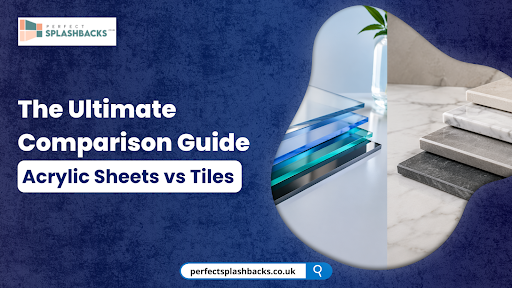
Walk into almost any UK kitchen built before 2015, and you will find tiles behind the hob. Then acrylic panels started turning up, and suddenly people were asking whether thirty years of tiling habits actually made sense.
This blog is for anyone sitting with that question right now, whether you are renovating a kitchen or redoing a bathroom.
A perspex sheet or acrylic panel might look like a simple swap, but the two materials behave quite differently in real life. Understanding that difference saves you from making a decision you will have to live with for the next decade.
What Tiles Actually Are, and Why People Still Use Them
Ceramic and porcelain tiles are fired at extremely high temperatures, somewhere between 1,000 and 1,200 degrees Celsius for porcelain. That process makes them genuinely hard and dense. A good quality porcelain tile is resistant to water, resistant to scratching, and will handle the heat from cooking without any issue at all. Behind a gas hob, especially tiles are one of the safest choices you can make.
The design variety is worth mentioning too. From tiny handmade zellige pieces to large-format stone-effect slabs, the range of what you can do with tiles is broader than almost any other material. If texture is something you want, tiles are the obvious answer. Acrylic simply does not offer the same tactile depth.
Individual tiles are also fairly cheap to buy. A box of standard ceramic wall tiles in the UK starts at around £10-£15 per square metre at the budget end. That number looks attractive until you add up everything else that comes with it.
The Part Nobody Mentions When They Quote You Tiles
Grout. That is the thing. It sits in every joint between every tile, and it starts clean and sharp, and within a year or two of cooking it turns grey. Behind the hob, cooking grease gets into the grout lines and does not come back out with a standard wipe. You end up scrubbing it with a stiff brush and bleach-based cleaner, which works for a while, but bleach weakens grout over time. Eventually, the joints start to crack and crumble. Then you are re-grouting, which is the kind of job that takes a full weekend and leaves you wondering why you did not just go with a panel in the first place.
Installation is a serious undertaking too. The wall needs to be prepped and primed if it is porous. Every tile goes up individually with adhesive, gets spaced, gets grouted, gets sealed. Around sockets and switches, each tile needs to be measured and cut precisely on site. One bad cut and the tile is wasted. A full kitchen splashback realistically takes two days minimum, and that is before you factor in drying time.
So What Is an Acrylic Splashback, Actually?
An acrylic sheet is made from Polymethyl Methacrylate, a thermoplastic known as PMMA. It is the same material used in aquarium viewing panels, aircraft canopies, and greenhouse glazing. Lightweight, non-porous all the way through, and shatter-resistant. Unlike a glazed tile, where only the surface layer is sealed, acrylic has no pores at all for water, grease, or mould to get into.
A single panel goes across your entire wall in one piece. No joints. No grout lines anywhere. That changes the cleaning equation completely — it becomes a wipe, not a scrub. The surface responds well to warm water and a soft cloth, and that is genuinely the beginning and end of maintenance.
Perfect Splashbacks sources its acrylic from leading manufacturers and backs it with a 10-year guarantee against discolouration. The material carries a Class 3 fire rating, identical to the specification of branded alternatives like Perspex. Density is 1.19 g/cm³ and light transmission on a 3mm clear sheet exceeds 92%. Spec for spec, quality acrylic from a reputable UK supplier matches branded sheet material consistently.
Also read: Common Mistakes to Avoid When Ordering Perspex Cut to Size
How Installation Actually Compares
Tiles behind a kitchen sink, with an extractor hood cut-out, power sockets on either side, and an awkward corner at one end: that job takes a skilled tiler the better part of a day and a half. The mess from cutting tiles indoors is real. Ceramic dust gets everywhere.
Perspex cut to size arrives at your door already cut to your exact dimensions. Socket holes pre-drilled if you need them. Edge polished if you asked for it. You clean the wall, peel the backing off the double-sided tape, press the panel into position, and seal the edges with a thin bead of silicone. Most people fit one in two or three hours on their own, without any trade experience at all.
That is not a minor difference. Losing your kitchen for two days during a renovation has a real impact on daily life. The ability to fit an acrylic sheet cut to size yourself, over a weekend morning, and be cooking in the afternoon is something a lot of homeowners genuinely value once they have experienced it.
How the Two Materials Stack Up Side by Side
|
Factor |
Ceramic Tiles |
Acrylic Splashback |
|
Surface |
Porous grout lines between every tile |
Completely seamless, non-porous |
|
Cleaning |
Regular grout scrubbing needed |
One wipe with a damp cloth |
|
Installation time |
1.5 to 2 days minimum |
2 to 3 hours DIY |
|
Socket cut-outs |
Cut on site, risk of breakage |
Pre-drilled to order |
|
Heat resistance |
Safe behind gas and electric hobs |
Electric hobs only, 50mm minimum clearance |
|
Individual damage |
Single tile replaceable |
Full panel replacement needed |
|
Discolouration guarantee |
Varies by manufacturer |
10 years from Perfect Splashbacks |
|
Texture options |
Extensive — matte, rough, stone-effect |
Smooth only |
The heat point is worth being clear about. Acrylic should sit a minimum of 50mm from any heat source. It must not be used behind an open gas flame. For gas hobs, aluminium composite panels are a far better fit, and Perfect Splashbacks stocks those too. For electric hobs, sinks, bathroom walls, utility rooms, and pretty much anywhere else, acrylic performs well.
What Acrylic Gives You That Tiles Cannot
Tiles can do texture. Acrylic does seamlessness. Those are different strengths, and which one matters depends entirely on the aesthetic you are going for.
A gloss acrylic sheet has a mirror-like finish that bounces light around the room. In a smaller kitchen where natural light is limited, that reflective surface makes a real difference to how spacious the space feels. The colour runs consistently through the whole sheet. So, chips along the edge do not reveal a different material underneath the way painted or printed surfaces can.
A frosted acrylic sheet takes a softer approach. The satin finish diffuses light rather than reflecting it directly, which suits bathrooms particularly well, or any room where a calmer, less glossy aesthetic is the goal. It is also popular for partition screens and privacy panels because it lets light pass through while obscuring the view.
Then there are coloured options. A coloured acrylic splashback lets you run a single unbroken block of colour from one edge of the wall to the other. Deep teal, warm sage, crisp white, bold black, the range at Perfect Splashbacks covers both strong statement colours and quieter neutrals. Tiles can offer colour too, but the grout lines always interrupt the visual. With acrylic, the colour is just there, clean and continuous.
Buying Tiles Off the Shelf vs Perspex Cut to Size
When you buy tiles, you buy more than you need. Industry guidance is typically to add 10% for wastage on straight runs, and 15% for diagonal layouts or rooms with lots of cut lines. Boxes come in fixed quantities, so you buy to the nearest full box. Offcuts go in the bin.
Perspex cut to size does not work like that. You give your wall dimensions, and the sheet arrives cut to those measurements. Perfect Splashbacks cuts to within ±3 mm on standard orders, and as precisely as 1mm depending on the cutting method. Free cut-to-size is included on all orders, alongside bespoke options such as edge polishing, custom shapes, hole drilling, and radius corners.
The acrylic sheet cut to size also arrives with the protective film still on, which you peel off during installation. There is no on-site cutting mess, no trips back to the shop because you underestimated, and no boxes of leftover tiles taking up space in the garage for three years.
Which One Is Actually Worth Your Money?
Tiles make sense in specific situations.
- Behind a gas hob
- In a kitchen that is heavily traditional
- In projects where the budget is very tight and the area is small
- If you want genuine texture, tiles are still the only material that delivers it at scale
For most other situations, quality acrylic is the more practical and often better-looking choice. It goes up faster, stays cleaner, costs less to maintain over time, and removes the grout problem entirely. The perspex sheet equivalent from a reliable UK supplier matches branded specification at a better value, and the cut-to-size service means the panel fits your wall exactly.
Perfect Splashbacks stocks gloss, frosted, metallic, and coloured acrylic across a wide colour range, all available with free cut to size, next-day delivery, and samples if you want to see the finish in person before committing.
Browse the full range at perfectsplashbacks.co.uk.
FAQs
1. What is a perspex sheet and how is it different from tiles?
A perspex sheet (also known as an acrylic sheet) is a lightweight, durable plastic material used as an alternative to traditional tiles. Unlike tiles, perspex sheets offer a seamless finish, are easier to install, and require less maintenance due to the absence of grout lines.
2. Are acrylic sheets better than tiles for kitchens and bathrooms?
Yes, acrylic sheets are often preferred for modern kitchens and bathrooms because they are waterproof, easy to clean, and provide a sleek, glossy appearance. Tiles, while durable, may require regular grout cleaning and maintenance.
3. Can I get acrylic sheets cut to size for my project?
Absolutely! Many suppliers offer acrylic sheet cut to size and perspex cut to size services, allowing you to get precise dimensions for splashbacks, wall panels, or custom installations.
4. What are the benefits of using a coloured acrylic splashback instead of tiles?
A coloured acrylic splashback provides a modern, vibrant finish with no visible joints. It is also heat-resistant, easy to clean, and quicker to install compared to tiled splashbacks.
5. Is a frosted acrylic sheet suitable for privacy areas?
Yes, a frosted acrylic sheet is ideal for areas requiring privacy, such as bathroom windows or partitions. It allows light to pass through while obscuring visibility, unlike standard tiles which are opaque.